What Is the Sagrada Familia? History, Gaudí and Key Facts
What is the Sagrada Familia? It’s a basilica in Barcelona, Sagrada Família in Catalan, and Antoni Gaudí’s best-known work, which he led from 1883 until his death in 1926. Its cornerstone was laid in 1882, and in 2026 its central Tower of Jesus Christ reached 172.5 m, making it the tallest church in the world. Work on the basilica is still going on.
What is the Sagrada Familia?
What is the Sagrada Familia? It’s a Catholic basilica in Barcelona, officially the expiatory church Temple Expiatori de la Sagrada Familia, and Antoni Gaudí’s best-known work. It’s also still a building site: construction started in 1882 and is continuing today. Masses are held there, and it’s open to visitors every day.
Its full name is the Temple Expiatori de la Sagrada Familia, an expiatory church. “Sagrada Família” is Catalan for “Holy Family”, and the building is dedicated to them. The foundation that builds and runs it is the Junta Constructora del Temple Expiatori de la Sagrada Familia.
Is the Sagrada Familia a cathedral?
No. On 7 November 2010, Pope Benedict XVI consecrated it and designated it a minor basilica. You’ll often hear it called “Gaudí’s cathedral”, but basilica is the correct term. It’s also a working parish church: regular Masses are held in Catalan, Spanish and English, alongside the daily flow of visitors.
The Sagrada Familia is best known today as a landmark on the Barcelona skyline and one of the city’s most visited sights, even while the ongoing construction continues around it.
Sagrada Familia history: timeline
| Year | What happened |
|---|---|
| 1882 | Bishop Urquinaona lays the cornerstone on 19 March. The original neo-Gothic design is by Francisco de Paula del Villar. |
| 1883 | Antoni Gaudí takes over the project. |
| 1885 | The Chapel of Saint Joseph in the crypt opens and the first Masses are held. |
| 1914 | Gaudí starts working exclusively on the Sagrada Familia. |
| 1925 | The Saint Barnabas bell tower on the Nativity façade is finished, the only tower Gaudí saw completed. |
| 1926 | Gaudí dies on 10 June. Domènec Sugranyes takes over. |
| 1936 | During the Spanish Civil War, plans and photographs are burnt and plaster models smashed. |
| 1961 | The museum is created. |
| 2005 | The Nativity façade and the crypt become UNESCO World Heritage, as part of the Works of Antoni Gaudí. |
| 2010 | Pope Benedict XVI consecrates the basilica on 7 November. |
| 2012 | Jordi Faulí becomes head architect. |
| 2021 | The Tower of the Virgin Mary (138 m) is inaugurated on 8 December. |
| 2023 | The four towers of the Evangelists (135 m) are inaugurated on 12 November. |
| 2026 | The Tower of Jesus Christ is completed on the outside in February and blessed by Pope Leo XIV on 10 June, the centenary of Gaudí’s death. |
Sagrada Familia and Gaudí
Gaudí took over the project in 1883, a year after the first stone was laid, and from 1914 he worked on nothing else. He saw only one tower finished: the Saint Barnabas bell tower on the Nativity façade, completed in 1925. He died the following year and is buried in the crypt.
Much of his material was lost in 1936, when plans and photographs were burnt and plaster models smashed. Work has continued under a series of architects since; Jordi Faulí has led it since 2012. You can learn more about Gaudí’s life and work in the museum, which is included in every ticket. See our museum and crypt page.
Architecture: Gothic roots, Gaudí’s own style
The first design, from 1882, was neo-Gothic, drawn up by Francisco de Paula del Villar. When Gaudí took over in 1883, he kept the Gothic floor plan but moved away from it in almost everything else, developing his own nature-inspired forms: branching, tree-like columns in the main nave, curved stone surfaces and towering spires rather than flat Gothic walls and flying buttresses. Inside, large stained glass windows flood the nave with colour. The result is often described as somewhere between late Gothic and Art Nouveau, but it’s really its own thing, built around Gaudí’s own geometry and his studies of natural forms.
The three facades
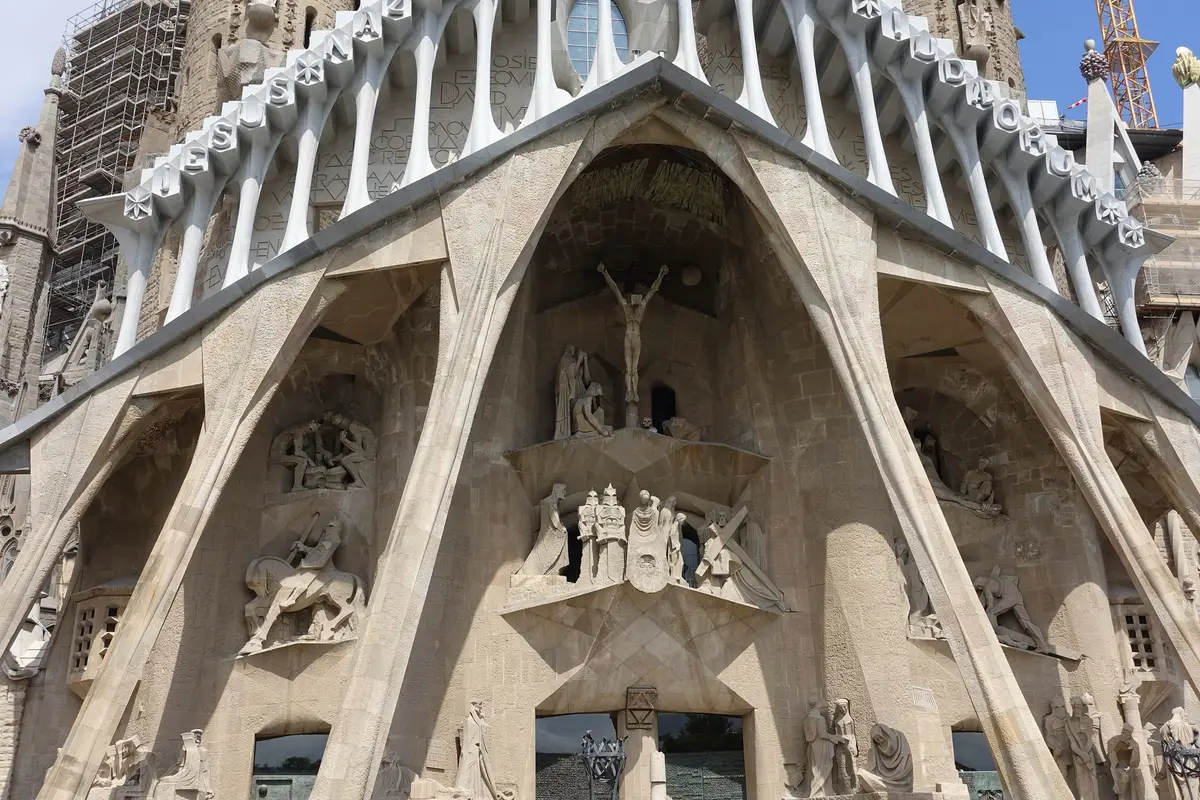
The Sagrada Familia has three main façades, each telling a different part of the story. The Nativity façade, the side most closely tied to Gaudí’s own lifetime, carries the Saint Barnabas bell tower he saw completed in 1925; it’s also where individual visitors enter today. The Passion façade faces the city centre and has the second tower open to visitors. The Glory façade, planned by Gaudí as the main façade and main entrance, is still to be built, and no completion date has been announced for it. Our facades page covers all three in detail.
Key figures
The Tower of Jesus Christ is 172.5 m tall. It’s the highest point of the basilica and, according to the official website, makes it the tallest church in the world. Its cross is 17 m tall and 13.5 m wide. The Tower of the Virgin Mary, at 138 m, is the second tallest, and the four Towers of the Evangelists are 135 m each.
You can go up one tower on the Nativity or Passion façade with a tower ticket; the lift takes you up and you walk down roughly 400 steps. The Tower of Jesus Christ isn’t open to visitors yet. Details on our towers page.
Inside the basilica
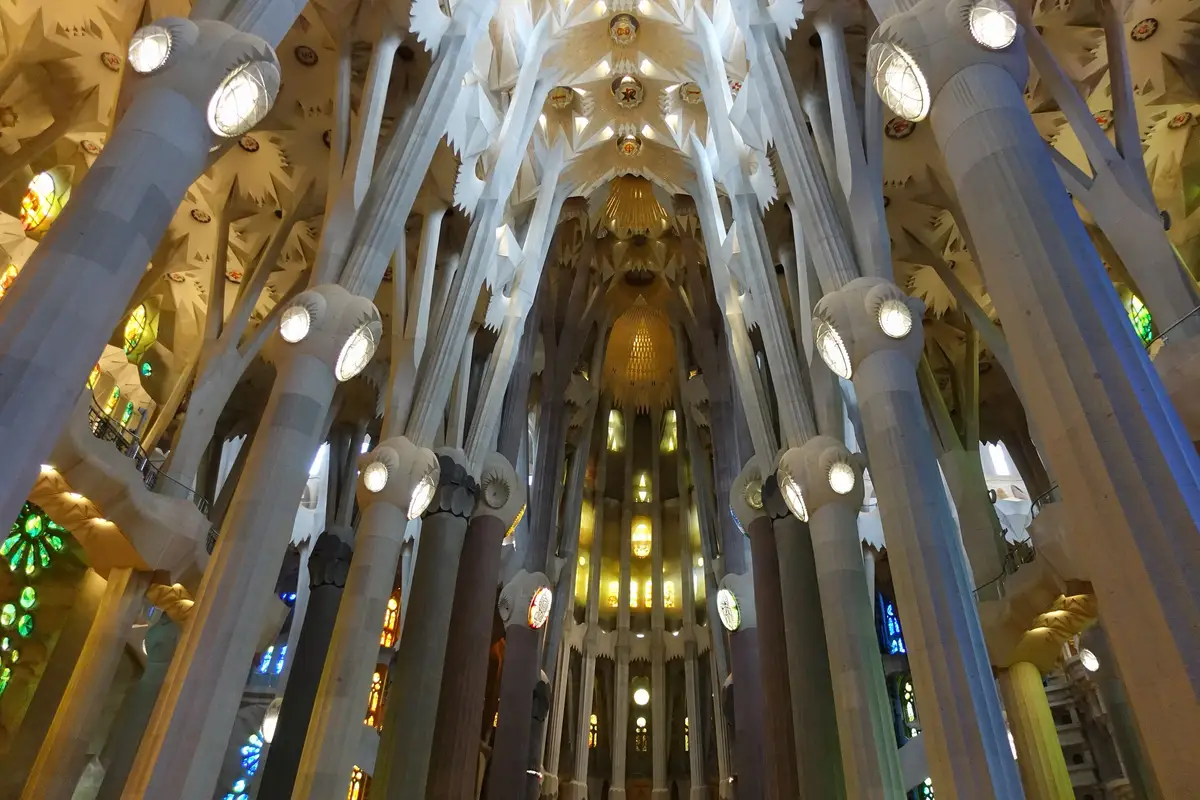
Inside, the basic ticket covers the full nave and the museum, which traces the Temple’s past, present and future and Gaudí’s life and work. You’ll see the branching columns and stained glass windows mentioned above from below, and you can step down into the crypt area, where Gaudí is buried, from the outside; a standard ticket doesn’t include crypt access. See our interior page for more.
Is the Sagrada Familia finished?
Not yet. The Tower of Jesus Christ was completed on the outside in 2026, but its interior, the Chapel of the Assumption and the Glory façade are still being built. There’s no official completion date. Our completion page has the latest status.
Visiting today
You visit with a timed ticket bought online; see the opening hours. The basic ticket on the official website includes the museum and the audioguide app, and under-11s go free. Outside, look for the Nativity and Passion façades; the Glory façade, planned by Gaudí as the main entrance, is still to be built. Read more on our facades page. Before you go, it’s worth checking the dress code and the entrance you’ll use.
Frequently asked questions
It’s Catalan for “Holy Family”. The full name of the foundation that builds it is the Junta Constructora del Temple Expiatori de la Sagrada Familia, so the building is officially an expiatory temple dedicated to the Holy Family.
No, it’s a basilica. Pope Benedict XVI consecrated it on 7 November 2010 and designated it a minor basilica. It’s often called “Gaudí’s cathedral”, but that isn’t its official status.
The first, neo-Gothic design was by the diocesan architect Francisco de Paula del Villar. Antoni Gaudí took over in 1883 and worked on it until his death in 1926. Since 2012 Jordi Faulí has been head architect.
Yes. Gaudí’s tomb is in the crypt. The crypt isn’t included in standard tickets; see our museum and crypt page.
Part of it is. In 2005, the Nativity façade and the crypt were added to the UNESCO list as part of the Works of Antoni Gaudí, a group listing that covers several of his Barcelona buildings.
Ready to see Gaudí’s masterpiece?
Compare every Sagrada Familia ticket, tour and combo and book a time slot in minutes.
Sagrada Familia Fast-Track Guided Tour
- Fast-track entry
- Expert live guide
- Museum included
from €44
Check best price Compare tickets